CppCon2025笔记之libc++

看到华人小哥,必须得关注一下,演讲题目是《Implement Standard Library: Design Decisions, Optimisations and Testing in Implementing Libc++》,作者Hui Xie是libc++的贡献者、BSI成员、WG21成员……谈了一些libc++中相关的设计决策、优化和测试细节。本文结合演讲视频和仓库幻灯片整理而来,任何转述错误和个人观点与原作者无关,推荐观看原视频,原作者的讲解更清晰。

std::expected

使用[[no_unique_address]]复用非C结构体因内存对齐而引入的尾部padding,考虑如下代码:

1
2
3
4
5
6
class Foo {
    int i;
    char c;
    bool b;
};
enum class ErrCode : int { Err1, Err2, Err3 };

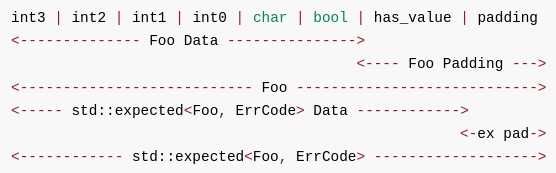
由于内存对齐,末尾有2字节的padding(先记住这一点),可以得出sizeof(Foo)为8,那么sizeof(std::expected<Foo, ErrCode>)是多少呢?如果使用libstdc++,结果是12,但是使用libc++,结果则是8,为什么呢?libc++的std::expected简化代码如下:

1
2
3
4
5
6
7
8
9
template <class Val, class Err>
class expected {
    union U {
        [[no_unique_address]] Val val_;
        [[no_unique_address]] Err err_;
    };
    [[no_unique_address]] U u_;
    bool has_val_;
};

/blog/cppcon2025_huixie90/expected0.png

因为 「The attribute-token no_unique_address specifies that a non-static data member is a potentially-overlapping subobject」class Foo不是C结构体,其尾部padding被复用了。收益是更小的内存占用,更好的缓存局部性,std::expected通常用于错误处理,并用于返回值,对于如下代码:

1
std::expected<Foo, ErrCode> compute() { return Foo{}; }

使用gcc和libstdc++编译输出的汇编代码如下:

1
2
3
4
5
6
7
compute():
        mov     DWORD PTR [rsp-24], 0
        xor     eax, eax
        mov     BYTE PTR [rsp-24], 1
        mov     ecx, DWORD PTR [rsp-24]
        mov     rdx, rcx
        ret

而使用clang和libc++编译输出的汇编代码如下:

1
2
3
compute():
        movabs  rax, 281474976710656
        ret

那么只有收益吗?想象一下,邻居家有一个大院子,一部分用于游泳池,一部分用于花园……还留有一些空地,作为其邻居,如果看到块空地没用,冒然将自己的物品放上去,会发生什么?自然是少不了一番邻里不合的景象了!假如将std::expected拷贝构造函数实现如下:

 1
 2
 3
 4
 5
 6
 7
 8
 9
10
11
12
template <class Val, class Err>
class expected {
  public:
    expected(const expected& other)
        : has_val_(other.has_val_) {
        if (has_val_) {
          std::construct_at(std::addressof(u_.val_), other.u_.val_);
        } else {
          std::construct_at(std::addressof(u_.err_), other.u_.err_);
        }
    }
};

乍一看,以上的代码是符合直觉的,但是如果尝试运行如下代码呢?

1
2
3
4
5
int main() {
    std::expected<Foo, int> e1(Foo{});
    std::expected e2(e1);
    assert(e2.has_value());
}

断言失败了!因为 「To zero-initialize an object or reference of type T means: … if T is a (possibly cv-qualified) non-union class type, its padding bits ([basic.types.general]) are initialized to zero bits and …」 ,邻居表示,我清扫自家院子,把空地的杂物扔了,也怪不得我啊!对于class Fooconstruct_at会将padding字段清零,附带着has_val_也被清零了,修复该问题的办法就是将has_val_的赋值挪到调用std::construct_at之后,修改如下:

 1
 2
 3
 4
 5
 6
 7
 8
 9
10
11
12
template <class Val, class Err>
class expected {
  public:
    expected(const expected& other) {
        if (other.has_val_) {
          std::construct_at(std::addressof(u_.val_), other.u_.val_);
        } else {
          std::construct_at(std::addressof(u_.err_), other.u_.err_);
        }
        has_val_ = other.has_val_;
    }
};

那么,问题被终结了吗?考虑std::expected套娃,代码如下:

1
2
std::expected<std::expected<Foo, ErrCode>, ErrCode> e = ...;
e.value().emplace(); // the inner expected construct_at will overwrite outer expected bool

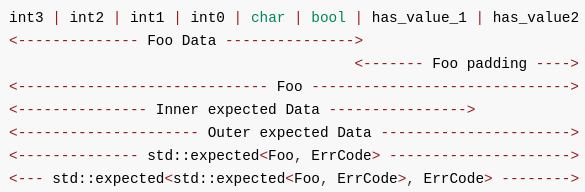
此时,std::expected的内存布局如下:

/blog/cppcon2025_huixie90/expected1_nest0.png

对内层的expected对象调用emplace,会调用construct_at将padding空间给清零,外层expectedhas_val_也附带着被清零了,这和前面拷贝构造函数的问题类似,更为直观的代码如下:

1
2
3
4
5
6
7
8
struct Bar {
    [[no_unique_address]] std::expected<Foo, ErrCode> e;
    char c;
};

Bar bar = ...;
bar.c = 'c';
bar.e.emplace(); // construct_at will overwrite c

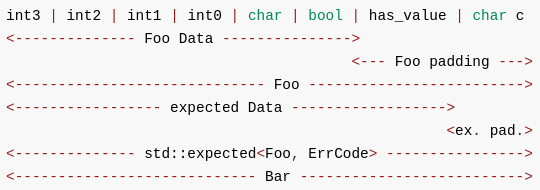
struct Bar的内存布局如下:

/blog/cppcon2025_huixie90/expected1_nest1.png

成员char c复用了前一成员的尾部padding空间,construct_at会将成员c的内存清零,以上代码中的字符写入成了无效操作!为了解决以上问题,再次修改代码:

 1
 2
 3
 4
 5
 6
 7
 8
 9
10
11
12
13
template <class Val, class Err>
class expected {
    struct repr {
        union U {
            [[no_unique_address]] Val val_;
            [[no_unique_address]] Err err_;
        };
        [[no_unique_address]] U u_;
        bool has_val_;
    };
 
    repr repr_; // no [[no_unique_address]] on this member
};

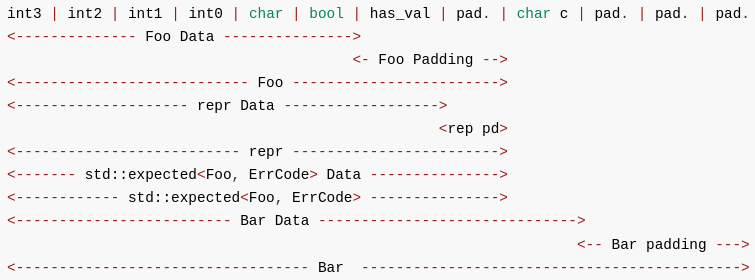
关键在于repr repr_;这行代码没有加[[no_unique_address]],这打断了[[no_unique_address]]的递归,char c不会再复用尾部padding,此时,struct Bar的内存布局如下:

/blog/cppcon2025_huixie90/expected2.png

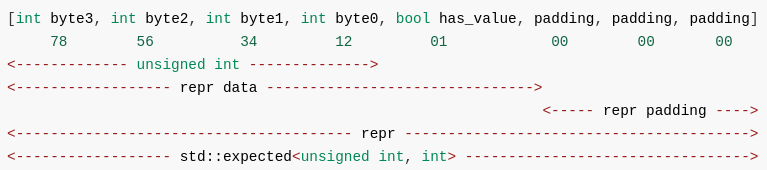
那么,经过以上修改,这就是最佳的代码了吗?如果std::expected传入的ValErr类型没有padding呢?比如std::expected<unsigned int, int>,成员bool has_val_将没有可以复用的尾部padding,其内存布局如下:

/blog/cppcon2025_huixie90/expected3.png

最终修改代码,添加对此种情况的分支处理,如下:

 1
 2
 3
 4
 5
 6
 7
 8
 9
10
11
12
13
14
15
16
17
18
19
20
21
template <class Val, class Err>
struct repr {
    union U {
        [[no_unique_address]] Val val_;
        [[no_unique_address]] Err err_;
    };
    [[no_unique_address]] U u_;
    bool has_val_;
};

template <class Val, class Err>
struct expected_base {
    repr<Val, Err> repr_; // no [[no_unique_address]]
};
template <class Val, class Err> requires bool_is_not_in_padding
struct expected_base {
    [[no_unique_address]] repr<Val, Err> repr_;
};

template <class Val, class Err>
class expected : expected_base<Val, Err> {};

当成员bool has_val_没有复用padding的时候,才添加[[no_unique_address]],即条件属性,此时repr<Val, Err> repr_的尾部padding是完全受控的,当前的expected不会读写这些尾部padding,因此可以安全地被外部复用。

以下为个人拙见,过去要实现potentially-overlapping子对象只能通过继承,现在使用组合加上[[no_unique_address]]属性也能实现,这意味着某个类即使带有final说明符也阻止不了overlapping,也不能有魔法代码去读写尾部padding,比如使用std::memsetstd::memcpy除了要求 trivially-copyable以外,还要求不能是potentially-overlapping的子对象,否则是UB,比如使用libc++的std::expected这样写就会有问题:

 1
 2
 3
 4
 5
 6
 7
 8
 9
10
11
12
13
14
15
16
17
18
19
20
21
22
23
24
25
class Foo final {
    int i;
    char c;
    bool b;
   public:
    void clear() noexcept {
        // *this = {}; // Good, but little bit slow.
        std::memset(this, 0, sizeof(*this)); // Bad, but fast.
    }
};

enum class ErrCode : int { Err1, Err2, Err3 };

static_assert(std::is_trivially_copyable_v<Foo>);

int main() {
    std::expected<Foo, ErrCode> e{Foo{}};
    
    static_assert(sizeof(e) == 8);

    e.value().clear();
    assert(e.has_value());
    return 0;
}
// clang++ -std=c++23 -stdlib=libc++

以上只是为了说明C++20引入[[no_unique_address]]之后的变化,而不是指libc++的std::expected实现存在问题。如果有尾部padding,又不想被复用,且不想手动填充对齐呢?标准也没有提供[[non_overlapping]]这样的属性啊! 想来简单的办法就是借用下transparent comparator这种方案,不想被复用的类型就加一行using non_overlapping = ???;这样的代码,输入此类型的模板类再使用is_non_overlapping检测下做相应处理,或者把逻辑反过来?

1
2
template <typename T>
concept is_non_overlapping = requires { typename T::non_overlapping; };

这样把工作转移给库作者了,也不太合适,那么用匿名结构体包裹一下呢?又不符合C++标准,还是手动对齐,远离魔法代码吧!

stop_token

stop_source, stop_tokenstop_callback是C++20提供的用于协作式地停止线程的3个组件,其中使用了一个共享的状态,大体实现如下:

 1
 2
 3
 4
 5
 6
 7
 8
 9
10
11
12
13
class stop_token {
  std::shared_ptr<__stop_state> state_;
};

class stop_source {
  std::shared_ptr<__stop_state> state_;
};
 
template <class Callback>
class stop_callback {
  [[no_unique_address]] Callback callback_;
  std::shared_ptr<__stop_state> state_;
};

其中的__stop_state可以实现如下:

1
2
3
4
5
6
7
8
class __stop_state {
  std::atomic<bool> stop_requested_;
  std::atomic<unsigned> stop_source_count_; // for stop_possible()
  std::list<stop_callback*> stop_callbacks_;
  std::mutex list_mutex_;
};
static_assert(sizeof(__stop_state) == 72);
static_assert(sizeof(stop_token) == 16);

libc++优化实现大体如下:

 1
 2
 3
 4
 5
 6
 7
 8
 9
10
11
12
13
14
15
16
17
class __stop_state {
  // The "callback list locked" bit implements a 1-bit lock to guard
  // operations on the callback list
  //
  //       31 - 2          |  1                   |    0           |
  //  stop_source counter  | callback list locked | stop_requested |
  atomic<uint32_t> state_ = 0;
 
  // Reference count for stop_token + stop_callback + stop_source
  atomic<uint32_t> ref_count_ = 0;
 
  // Lightweight intrusive non-owning list of callbacks
  // Only stores a pointer to the root node
  __intrusive_list_view<stop_callback_base> callback_list_;
};
static_assert(sizeof(__stop_state) == 16);
static_assert(sizeof(stop_token) == 8);

首先是充分利用原子变量的每一个比特,不再使用std::mutex,然后是改用侵入式shared_ptr和侵入式链表,__stop_state内存占用大幅减小,stop_token降低为一个指针大小。

ranges

Segmented Iterators

1
2
3
4
5
6
7
8
9
std::deque<int> d = ...
// 1
for (int& i : d) {
    i = std::clamp(i, 200, 500);
}
// 2
std::ranges::for_each(d, [](int& i) {
    i = std::clamp(i, 200, 500);
});

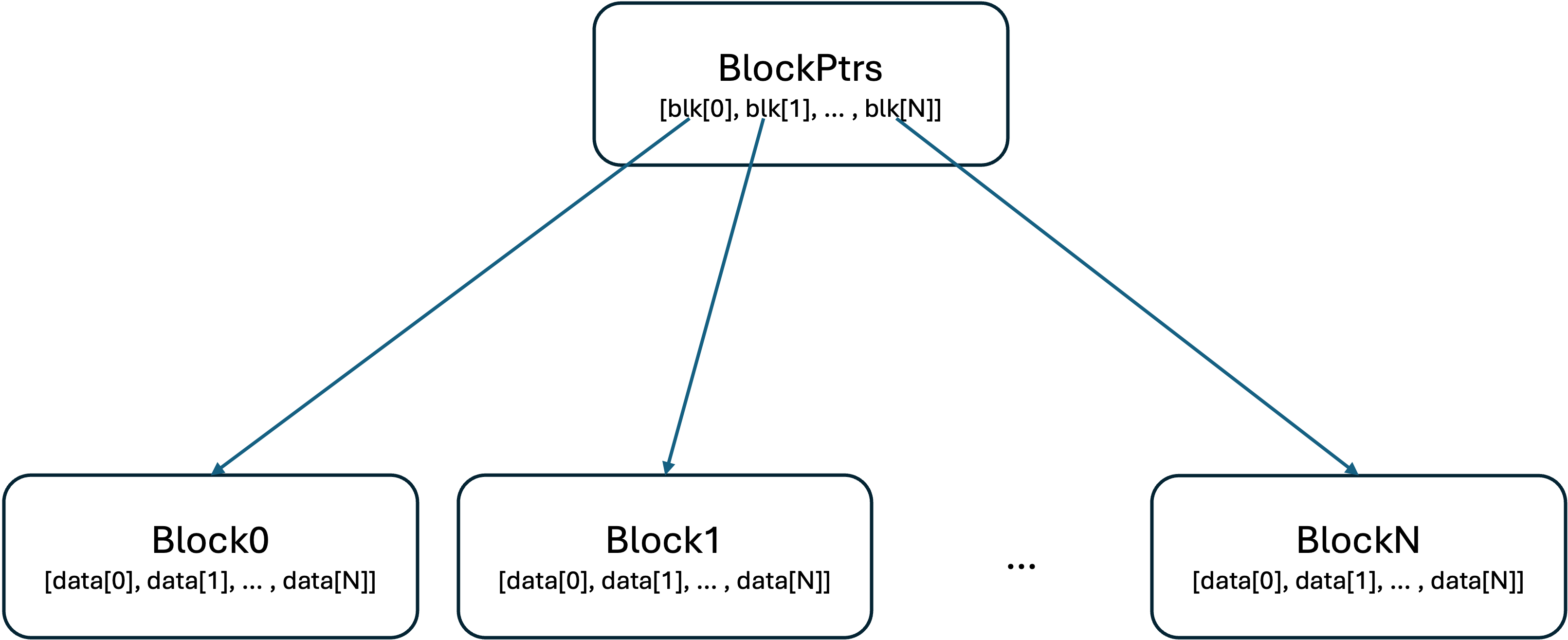
以上代码的std::ranges::for_each版本要快得多,原因和std::deque的设计有关,该容器是用block组织的,std::ranges::for_each采用双层循环,契合了std::deque的设计。 /blog/cppcon2025_huixie90/deque.png

ranges::copy

 1
 2
 3
 4
 5
 6
 7
 8
 9
10
11
12
std::vector<std::vector<int>> v = ...;
std::vector<int> out;
// 1
out.reserve(total_size);
for (const auto& inner : v) {
  for (int i: inner) {
    out.push_back(i);
  }
}
// 2
out.resize(total_size);
std::ranges::copy(v | std::views::join, out.begin());

std::ranges::copy要快很多,是因为对于以上情形,其内部调用的是std::memmove,代码如下:

 1
 2
 3
 4
 5
 6
 7
 8
 9
10
11
12
13
14
template <class Iter, class OutIter>
  requires is_segmented_iterator<Iter>
pair<Iter, OutIter> __copy(Iter first, Iter last, OutIter result) {
  std::__for_each_segment(first, last, [&](auto inner_first, auto inner_last) {
      result = std::__copy(inner_first, inner_last, std::move(result)).second;
  });
  return std::make_pair(last, std::move(result));
}
template <class In, class Out>
  requires can_lower_copy_assignment_to_memmove<In, Out>
pair<In*, Out*> __copy(In* first, In* last, Out* result) {
  std::memmove(result, first, last - first);
  return std::make_pair(last, result + n);
}

flat_map Insertion

 1
 2
 3
 4
 5
 6
 7
 8
 9
10
11
12
13
14
// flat_map<int, double>
class flat_map {
  std::vector<int> keys_; // always sorted
  std::vector<double> values_;
  [[no_unique_address]] std::less<int> compare_;
};
std::flat_map<int, double> m1 = ...;
std::flat_map<int, double> m2 = ...;
// 1
for (const auto& [key, val] : m2) {
  m1.emplace(key, val);
}
// 2
m1.insert_range(m2);

使用insert_range更快,代码如下:

 1
 2
 3
 4
 5
 6
 7
 8
 9
10
11
12
13
14
15
16
17
18
19
20
21
template<container-compatible-range<value_type> R>
constexpr void insert_range(R&& rg) {
  __append(ranges::begin(rg), ranges::end(rg)); // O(M)
 
  auto zv = ranges::views::zip(keys_, values_);
  ranges::sort(zv.begin() + old_size, zv.end()); // O(MLogM)
 
  ranges::inplace_merge(zv.begin(), zv.begin() + old_size, zv.end()); // O(M+N)
 
  auto dup_start = ranges::unique(zv).begin(); // O(M+N)
  __erase(dup_start); // O(M+N)
}

template <class InputIterator, class Sentinel>
void __append(InputIterator first, Sentinel last) {
  for (; first != last; ++first) {
    std::pair<Key, Val> kv = *first;
    keys_.insert(keys_.end(), std::move(kv.first));
    values_.insert(values_.end(), std::move(kv.second));
  }
}

以上代码中的__append是使用for循环一个个插入元素的,还可以更快,作者引入了product_iterator这个concept,代码如下:

 1
 2
 3
 4
 5
 6
 7
 8
 9
10
11
12
13
template <class Iter>
  requires is_product_iterator_of_size<Iter, 2>
void __append(Iter first, Iter last) {
  using Traits = product_iterator_traits<Iter>;

  keys_.insert(keys_.end(),
      Traits::template get_iterator<0>(first),
      Traits::template get_iterator<0>(last));
 
  values_.insert(values_.end(),
      Traits::template get_iterator<1>(first),
      Traits::template get_iterator<1>(last));
}

Testing in libc++

这部分没细看了……对不住了……

另外

purecpp每年也有大会,今年的正在筹办,感兴趣的公司或个人可以去支持下!

0%